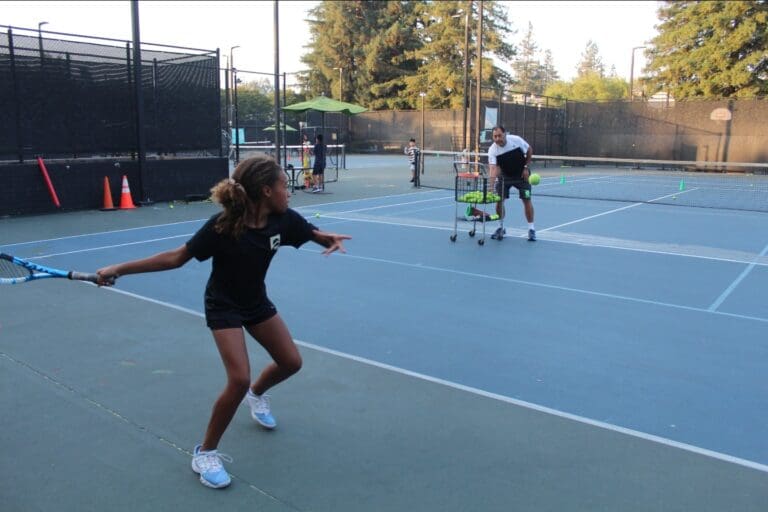
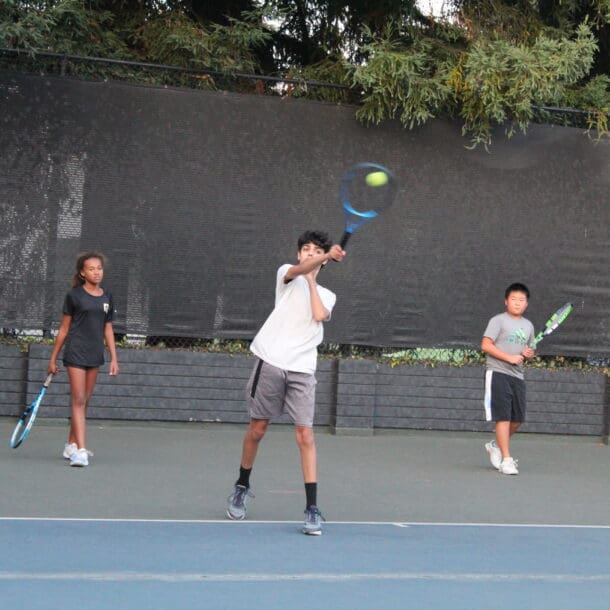
Every competitive adult tennis player has experienced the deep frustration of hitting a habit wall. You might take high-qualitytennis lessons in Mountain View, understand a technical correction perfectly in your mind, and execute a flawless forehand or serve during a relaxed feeding drill. Yet, the moment you step into a high-pressure match or face a fast-paced rally, your body instantly defaults to its old, flawed swing path: hitting late, collapsing the wrist, or muscling the ball across the court
Why is changing an ingrained physical habit so difficult, even when we consciously know the movement is wrong? At theSilicon Valley Tennis Academy (SVTA), head coach Coach Francisco Ruiz combines classical court instruction with cutting-edge sports neuroscience. Drawing on research published in the ITF Coaching and Sport Science Review, Coach Francisco Ruiz teaches adult players that bad technical habits are not personal failures of willpower; they are deeply entrenched neurological circuits in the brain. By understanding how the brain creates motor pathways and applying targeted training protocols, players takingtennis lessons in Mountain View can successfully rewire their neural architecture and unlock lasting technical breakthroughs.
The Neuroscience of Tennis Habits: Hebb’s Law
To understand why technical changes require deliberate effort, we must examine how motor habits are formed in the human brain. In 1944, Canadian psychologist Donald Hebb formulated a foundational rule of neuroscience: neurons that fire together, wire together.
When a tennis movement, such as a specific backswing or contact point, is repeated hundreds of times, the brain creates strong synaptic connections between the neurons responsible for that action. In his research on habit modification, sports psychologist Claudio Sosa uses a vivid analogy to illustrate this phenomenon: imagine crossing a mountain covered by a dense, thick forest.
The First Attempt: The first time you walk through the forest, you must hack through heavy brush and deep undergrowth. It requires immense physical effort and mental energy, leaving only a faint, barely noticeable mark along the trail.
The Ingrained Highway: If you walk along that exact same path every day for months, the undergrowth disappears, leaving a wide, clearly paved dirt road. Naturally, whenever you need to cross the mountain, your brain automatically chooses the easy, paved highway because it requires almost no energy expenditure.
In tennis, when a stroke or thought pattern becomes automatic, it leaves a paved highway in your neural circuitry. When Coach Francisco Ruiz asks you to change your grip, prepare earlier, or alter your follow-through, your brain is being asked to abandon its familiar highway and trek back through the dense, energy-consuming forest. Because the brain’s primitive survival mechanisms naturally prefer familiar, low-energy routines, it resists the change and treats the old habit as preferable, even if that old habit causes you to hit the ball into the net! This is why structured instruction atSilicon Valley Tennis Academy focuses on systematic neural rewiring rather than simple repetition.
Self-Directed Neuroplasticity: The 30-Day NASA Guideline
How do we force the brain to build a new neural highway? The answer lies in self-directed neuroplasticity: the brain’s remarkable ability to reorganize its neural connections in response to conscious expectations, focused attention, and deliberate practice.
To overwrite an old technical habit, players must understand that a single lesson or occasional practice session is not enough. Research conducted by NASA specialists on motor adaptation established that it takes a minimum of 30 consecutive days of focused practice to construct new, stable neuronal pathways in the brain and fully incorporate a new physical habit.
When an old habit results in an error during practice, the worst thing a player can do is immediately grab another ball and hit again without stopping. Fast, mindless repetition only reinforces the existing bad habit! Instead, neuroscientists recommend introducing a deliberate pause. Stop, take a deep breath, and walk to the back of the court. This intentional pause interrupts the brain’s automatic error loop, suppressing negative emotional frustration and giving the prefrontal cortex time to consciously process the correct movement path before the next attempt.
2. Lowering Power for High Coordination
When players hit with maximum force, coordination rapidly deteriorates. Biomechanical studies demonstrate that stroke coordination and fluid timing drop significantly when players hit above 60% of their maximum power. During the habit-rebuilding phase, Coach Francisco Ruiz instructs players to slow down their swing speed to 50% or 60%. Lowering the pace reduces muscle tension in the arm and wrist, allowing the Central Nervous System (CNS) to feel the subtle via-points of the swing.
3. High-Concentration Series
Neuroscience research highlights that maximum self-directed concentration is far more effective for neural change than long, fatigued sessions. Following the training philosophy of elite sports coaches, it is significantly better to train in short, 5-minute series of maximum mental concentration than 30 consecutive minutes of sloppy, exhausted repetition. Every instructor offeringtennis lessons in Mountain View through our program enforces these focused bursts to maximize retention.
Kinaesthetic Shadowing and Body Schema Awareness
To build new neural trails without the distraction of the ball, Coach Francisco Ruiz heavily incorporates shadowing (executing precise tennis swings without physical contact with a ball) into ourtennis lessons in Mountain View.
According to technical learning researcher Jean-Luc Cotard, slow-motion shadowing connects the brain directly to the body’s body schema: our internal sensory map of body parts in space. When you perform a swing at an exaggeratedly slow pace, the sensation of heaviness in your arms, racket, and legs increases significantly due to gravity.
This increased heaviness forces your Central Nervous System to activate thousands of sensitive kinaesthetic, proprioceptive, and exteroceptive sensors. This heightened awareness allows you to feel joint via points, correct your balance before contact, and eliminate the technical fall, which is uncontrolled movement caused by gravity.
Furthermore, Coach Francisco Ruiz utilizes subconscious coaching cues to bypass an over-analytical mind:
To fix a truncated follow-through: Players are instructed to catch the racket over their opposite shoulder with their non-dominant hand.
To ensure full hip and shoulder rotation: Players are trained to pose at the finish of the stroke with their back foot turned onto the tip of the toe.
To relax grip pressure: Players release their fingers at the follow-through, instantly increasing wrist flexibility, fluidity, and acceleration.
Overcoming the Habit Wall with SVTA
Rewiring your physical habits requires deliberate structure and expert guidance. When you commit to training at theSilicon Valley Tennis Academy, you gain direct access to proven motor-learning strategies designed to accelerate your growth on the court. Coach Francisco Ruiz ensures that every drill serves a clear neurological purpose, allowing you to transition from conscious effort to automatic execution.
Breaking a stubborn tennis habit is not a matter of luck; it is a structured, scientific process. By enrolling intennis lessons in Mountain View at theSilicon Valley Tennis Academy and working directly with Coach Francisco Ruiz, you will gain the tools to master self-directed neuroplasticity. By embracing deliberate pauses, slowing down your practice pace to 60% power, and dedicating 30 days to slow-motion shadowing, you can overwrite old motor mistakes, rewire your brain, and build a smooth, repeatable, championship stroke.