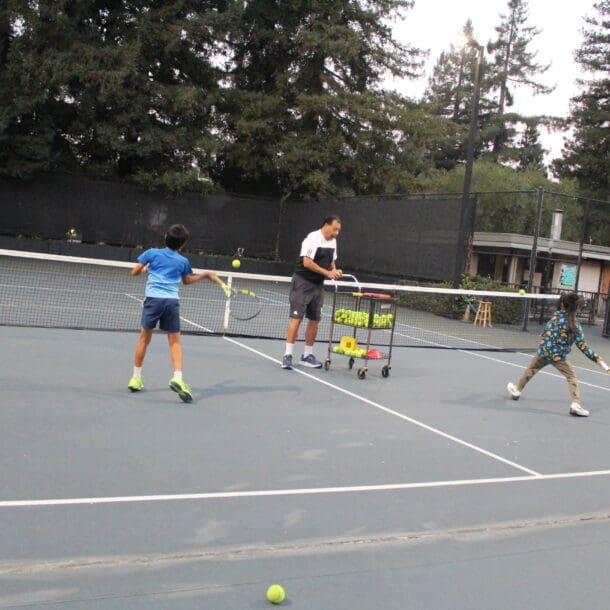
When competitive adult players sign up for high-performance tennis lessons in Mountain View at the Silicon Valley Tennis Academy (SVTA), they often assume that matchplay strategy begins only after the first game score is called. They spend their practice time perfecting stroke mechanics, developing heavy topspin, or tweaking their serve toss. However, under the guidance of head coach Coach Francisco Ruiz, players learn that the contest actually begins the very second they step onto the court for the pre-match warm-up.
Most recreational and club players treat the five-minute pre-match warm-up as a casual, brain-dead routine: hitting balls mindlessly down the middle, ignoring their opponent’s subtle movement patterns, and flailing away without a plan. In contrast, Coach Francisco Ruiz teaches adult competitors to approach the warm-up as a high-yield diagnostic audit. By analyzing how an opponent moves, prepares, and reacts during these initial five minutes, you can collect vital tactical intelligence, construct a mental game plan, and prepare to exploit their mechanical weaknesses the moment the match begins.
Taking structured tennis lessons in Mountain View gives players a massive competitive edge because it reshapes how they observe the game. Instead of focusing purely on their own shotmaking, players learn to view the court as a tactical chessboard. The pre-match dynamic sets the tone for everything that follows. When you enter the court with a purposeful diagnostic routine, you immediately signal to your opponent that you are present, focused, and ready to battle.
The Brad Gilbert Golden Rule: Prettiest in Warm-Up, Ugliest Under Pressure
In his classic sports strategy manual Winning Ugly, former world No. 4 Brad Gilbert formulated one of the most famous axioms in competitive tennis: “The strokes that are prettiest in the warm-up are often the ugliest under pressure.”
Recreational players are frequently intimidated during the warm-up when they see an opponent striking clean, aesthetic, effortless groundstrokes down the middle of the court. They make the dangerous mistake of overestimating the opponent’s ability, assuming they are facing an unbeatable ball-striker.
However, as Coach Francisco Ruiz reminds students in our tennis lessons in Mountain View, a relaxed warm-up carries zero emotional risk. There are no scorelines, no pressure points, and no physical movement demands. A player may possess smooth, beautiful stroke mechanics when fed balls directly to their strike zone, yet completely collapse when forced to hit on the run, low at their feet, or under set-point pressure.
Pressure is the ultimate truth-teller in tennis. Under high-stakes pressure, a player’s deepest technical flaws, movement glitches, and emotional vulnerabilities are magnified. The goal of a smart, thinking player is not to be awed by an opponent’s warm-up, but to actively probe for the subtle structural cracks that will break apart once the match gets tight. Players who train regularly at the Silicon Valley Tennis Academy learn to recognize these subtle cracks instantly.
Understanding this principle completely changes your psychological posture. Instead of feeling defensive when an opponent uncorks heavy forehands during practice rallies, you remain patient. You recognize that warm-up beauty is often a cosmetic illusion. Real matchplay requires adjustment, physical endurance, and emotional resilience under stress.
The 5-Step Pre-Match Scouting Checklist
During our advanced tennis classes in mountain view and private lessons at the Silicon Valley Tennis Academy, Coach Francisco Ruiz trains players to execute a disciplined, five-step diagnostic checklist during the seven-to-eight-minute warm-up window:
The Middle-Court Step & Stance Preference Hit a neutral ball directly down the center line of the court toward your opponent’s body. Watch their immediate footwork reaction: Do they step around the ball to favor their forehand? If so, they have just telegraphed that they lack confidence in their backhand. Do they prepare with an open stance or a closed stance? A player who relies exclusively on a closed, crossover stance often struggles to recover laterally on fast hard courts.
The Net Play & Overhead Diagnostic When your opponent comes to the net to practice volleys, do not feed them easy, waist-high balls. Test their physical range and footwork: Throw up a high, unexpected lob. Watch how they cover it. Do they turn their shoulders and crossover efficiently, or do they backtrack clumsily in a straight line? Hit a soft, low ball at their feet. Observe whether they bend their knees to absorb the low contact point or simply drop their racket head (known as the “lazy-man volley”). A player who drops their racket head without bending their knees will consistently dump low volleys into the net during actual matchplay.
The Service Toss & Spin Analysis When observing your opponent’s serve, pay close attention to the position of their toss relative to their head: Is the toss consistently placed inside the court at 1 o’clock? This indicates a flat or slice serve that you can anticipate on fast courts. Does the toss drift back over their left shoulder (for a right-handed player)? This signals a kick serve. Observing this early allows you to adjust your return positioning, stepping back or taking the ball on the rise before it jumps above your shoulder.
Sitter Response & Over-Hitting Tendencies Feed your opponent a short, high-bouncing ball in the mid-court. Watch their swing speed: Do they take a smooth, controlled approach shot, or do they attempt to smash the ball as hard as possible? Players who try to tear the ball apart on short sitters during the warm-up suffer from poor emotional regulation. Under match pressure, these players will routinely commit unforced errors by over-hitting short balls into the back fence.
Emotional Body Language & Breathing Patterns Observe how your opponent handles small mistakes during the warm-up: Do they sigh, shake their head, or mutter negative comments after missing a warm-up shot? This reveals high internal anxiety and unrealistic perfectionism. Against an emotionally volatile player, your primary game plan should be patience: extend the rallies, keep the ball deep, and let them defeat themselves through frustration.
Developing a Process-Oriented Game Plan
Once you have gathered this diagnostic information, you must translate it into a clear, concise strategy before the first serve. In his coaching guide Teaching Tennis, veteran coach Martin van Daalen emphasizes that a match game plan must be kept short, structured, and doable. Overloading your brain with complex tactics creates mental paralysis.
At the Silicon Valley Tennis Academy, Coach Francisco Ruiz teaches adult competitors to structure their warm-up observations into a simple Three-Point Execution Plan:
Where to Serve & Start the Rally: Direct your primary serves toward the opponent’s weaker wing or body position identified in the warm-up.
How to Return & Neutralize: If the opponent possesses a big first serve, shorten your backswing, focus on deep central placement, and eliminate unforced return errors.
How to Finish the Rally: Utilize open-court patterns: pulling the opponent wide to their strong side first to open up the court, then attacking their weaker, slower-recovering wing.
Executing this process-oriented strategy allows you to stay grounded when points get stressful. Rather than worrying about the scoreboard, your mind stays locked onto specific targets and tactical objectives. Every mistake by the opponent validates your pre-match observations and builds your internal momentum.
Building Tactical Awareness in Every Training Session
Mastering this analytical mindset requires consistent practice on the court. It is not something you can simply turn on during a tournament final if you have never practiced it during weekly training. This is why Coach Francisco Ruiz incorporates tactical scouting drills directly into daily routines at the academy.
During competitive sparring sessions, players are asked to identify their partner’s preferred target zones within the first three games. They track shot depth, note recovery speeds, and evaluate how opponents adjust when forced off the baseline. By turning observation into an automatic habit, players enter every official match with a heightened level of court awareness.
Taking high-quality tennis lessons in Mountain View ensures that your technical growth goes hand in hand with your tactical development. You learn to hit with purpose, move with efficiency, and outthink your opposition from the very first point. Under the leadership of Coach Francisco Ruiz, players transform from simple ball-strikers into complete, strategic competitors.
Conclusion
Winning in competitive tennis is rarely about who hits the prettiest shots; it is about who thinks most clearly under pressure. By enrolling in tennis lessons in Mountain View at the Silicon Valley Tennis Academy and training under Coach Francisco Ruiz, you will learn to master the mental and tactical side of the sport. Stop treating the pre-match warm-up as a passive routine. Step onto the court with an analytical mind, execute your scouting checklist, uncover your opponent’s pressure points, and transform every match into a calculated strategic victory.